

How To Draw A M4 Sherman Tank
Edifice a Second Generation M4A1 Sherman
Article past Stephen "Tank Wisperer" Brezinski
sbrez(at)suscom-maine(dot)net
concluding updated 26 April 2008.
Introduction And a Note on Classification & M4A1 Vehicle History
According to my references, Sherman is a proper name bestowed upon the American M4 series of medium tanks by the British upon their introduction and combat in North Africa during 1942. The outset M4 version produced was the M4A1 with a cast hull, followed by the welded-hull M4A2 and so the welded-hull M4. As well having either a bandage hull or welded hull or blended welded hull & bandage bow, the main differences betwixt the variants was in the engine which was reflected with different engine decks and exhausts. The M4A1, which is the subject of this review, besides as the M4 tanks were both powered by the Continental radial air-cooled gasoline engine borrowed from the aircraft industry. I understand that the diameter of this radial engine is the major reason the tank has such a high profile. In early 1944, the Us Army began to upgrade the original 75-mm M4A1 with a new larger T-23 turret and 76-mm M1A1 higher velocity gun of 52-calibers.
Up until late 1944, M4 variants all had a Vertical Volute Spring Pause [VVSS], like to that on the M3 medium tanks. In late 1944 the Horizontal Volute Jump Suspension [HVSS] was introduced offering a wider track with less ground pressure and better flotation.
This construction review covers several 1/72-calibration styrene plastic kits of the medium tank M4A1(76)Due west VVSS. The W indicates wet, water-filled, ammunition bins that were supposed to reduce the chance of an ammunition fire. Since most, peradventure all, 76-mm gun armed M4'due south had wet stowage, the wet-stowage appears to be assumed by many writers and modelers and the West is often dropped. About all 76-mm armed Shermans are as well what are called 'big-hatched' M4's, meaning that the forepart hulls have the 47 degree glacis and large driver and assistant-driver hatches. I say 'most all 76-mm armed Shermans' because a number of original Shermans with the 56 degree glacis, smaller turret and small driver hatches were upgraded afterward WW2 with the 76-mm M1A1 gun.
You'll notice that in the review we take no scans or photos of the kit sprues and individual parts. This is intended to exist a construction review of 3 similar subjects. At several websites we can detect good in-the-box reviews of these kits that fulfill that demand.
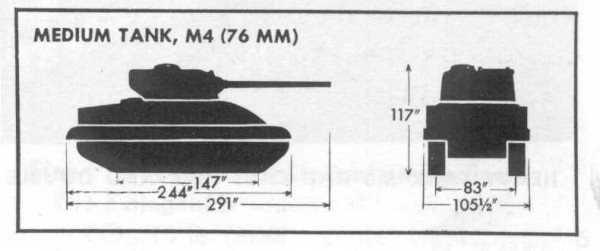
From a US Authorities publication, this drawing gives usa a reference to judge our M4A1(76) VVSS, 76-mm M1A1 gun armed, Sherman kits against. When comparison Sherman kits divide the inches by 72 for the i/72 scale equivalent. Differences in vehicle lengths in different references may exist partly due to the presence of fenders and sand skirts or non. My references notation minor differences in length of the M4A1, M4 and M4A2 hulls. All appear to have a hull width of 103 inches. Annotation that the Shermans fitted with the Horizontal Volute Spring Break [HVSS] would be wider; and Shermans fitted with a muzzle pause on the 76-mm gun would be slightly longer.
The Kits
Covered in this review is the now old Revell estimation of the M4A1 [a.g.a. Matchbox kit #40181,Revell AG #03102; or Monogram #2321]; then Trumpeter'southward Model's new M4A1 kit #7222; and last a conversion using ESCI's [Italeri's] late M4A1 hull and the LEVA Productions resin T-23 turret. Scans of the kit sprues can be seen already at other websites so I will not include them here.
Alas, I assembled my models and wrote the bulk of this review only prior to the release of Dragon Model's M4A1(76) kit and so was not able to build information technology with the others.
One may ask, "why would I wish to build an evidently poor model [such as the Revell or the LEVA turret] when there are much more accurate kits available. My answer is that I personally bask seeing how well I can meliorate upon an item with a problem. I besides do non wish to relegate a kit to the dustbin that I spent practiced money on. At the time the Revell and the LEVA items were released, they were the just M4A1(76) tank items commonly available.
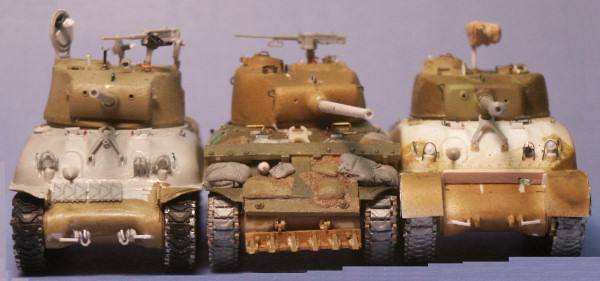
The photo above shows the front of all three kits side past side. All three are fully assembled just but partially painted. At far left is the Trumpeter model being built every bit an Israeli Sherman with features of a mid-World War 2 M4A1(76) used by Israel circa 1961. In the center is the ESCI M4A1 hull topped off past the Revell kit'sT-23 turret being modeled as an initial production M4A1(76) serving in Normandy, 1944. The Revell turret was used on the ESCI hull in social club to have an initial production T23 turret, On its bow is sandbag armor and a slightly crooked Cullin hedgerow cutter produced by LEVA Productions in resin.
At far correct is the Revell M4A1(76) with the tardily state of war features of a muzzle interruption on its 76-mm gun and an oval loader's hatch. The LEVA turret has great surface texture and details just is noticeably and inaccurately lower than the Revell and the Trumpeter T-23 turrets. This LEVA Productions squat turret is fine for wargaming perhaps, but looks besides odd to me for a fine brandish model.
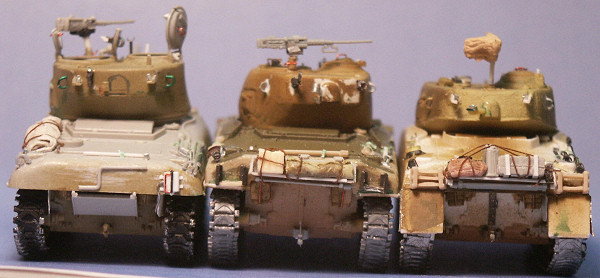
The stern of the iii models with the Trumpeter kit at far left. Annotation that ESCI's and Revell's stern accept a raised cutout, or notch, in the upper hull rear exposing more of the rear engine doors. This difference is discussed more later in this article. Equally a tardily M4A1 the Trumpeter model has a scratchbuilt phone box on the right rear merely besides note that Trumpeter's T-23 turret has no ventilator on its rear, particular to the initial T23 turrets. The model does have what appears to exist an additional exterior cooling unit on the hull rear. The lift rings on all turrets and hulls were replaced by copper wire. The ESCI and the Revell models take spare parts stolen from Trumpeter and Dragon kits

Going from left to right be the light gray Trumpeter model, the ESCI hull & Revell turret in the center, and the white Revell hull with the LEVA Productions resin cast turret at far correct. All three kits are roughly about the same length, which is nice to run across, except Revell's hull which appears too narrow and a smidgen short. The driver and co-driver hatches on the ESCI and Revell hulls can be modeled open up, Trumpeter's hull hatches are molded shut. Trumpeter's kit got spare plastic periscope guards from Dragon's M4 kits; while ESCI and Revell got etched brass periscope guards from Eduard and Extra Tech etched brass frets.
All three models had the forwards ventilation dome just aft of the co-driver'due south hatch stock-still. Trumpeter's and Revell's vent domes were shaved off and raised and so there is a gap underneath. ESCI'southward vent is odd in that it is recessed below the top of the hull, which I have never seen in photos of a real M4A1. The recess in the model's hull was filled in with modeling putty and the rather small ventilation dome rebuilt a little more accurately.
All iii hulls and the two styrene turrets were all roughed upwardly a tad to correspond a cast steel texture past coating them in slow drying liquid cement and and so stippled with a stiff toothbrush, and then allowed to dry. In the to a higher place scan we can meet that Trumpeter's turret hatches are oddly much larger than they should be, a surprising mistake to brand. The rolled-up tarp on the left rear hull of the Trumpeter kit was used to cover up a poor molded-on shovel.
The Revell & Leva Productions Conversion
When the Revell kit was released in the mid 1990's I had greatly welcomed it since ESCI had merely gone out of production and information technology was the simply ane/72 calibration Sherman on the market and different from the ESCI M4(75), and the world of resin models was however in its infancy. This M4A1 was initially released under the Monogram and the Matchbox labels, under license to Revell AG. The Revel M4A1 kit in this review is the Matchbox kit #40181 and was molded in white styrene. Compared to the ARMO, MR Models, Dragon and Trumpeter Sherman kits; the Revell kit is very 'accurateness-challenged' to be nice, even by 1995 standards. The Revell M4A1 tracks take no guide teeth effectually the idler, the roadwheels are also large, the chief gun (function 5) has a fictitious long raised band at its base, and features like the headlights and tools are simplified. The overall shape is off but non too bad though [my personal opinion]. Fortunately Eduard produces a very helpful etched contumely fret for the Revell M4A1, with parts to also greatly help the ESCI and the Trumpeter Sherman models.
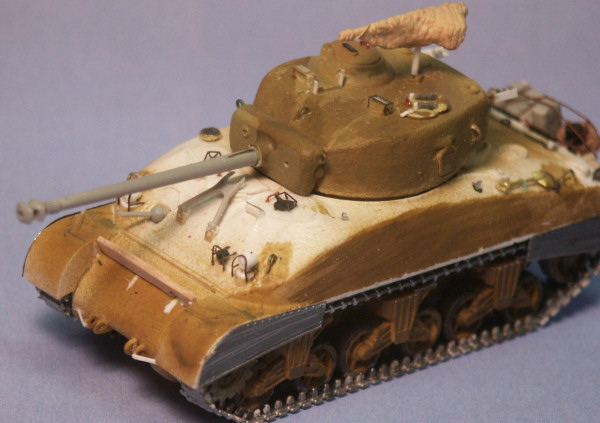
My interpretation of the Revell M4A1(75) with many of the actual Revell parts replaced. The turret is a resin-replacement T23(76) turret from LEVA originally fabricated for the ESCI M4A1. Turret bandage texture and casting seams are very nice though a chip overstated, simply the turret peak is noticeably way too low which makes the model look odd; the loader's hatch is likewise raised where it should be flush with the turret roof. The canvas covered 50-cal. AA mg is also from LEVA. The gun travel lock is front end the ESCI M4A1. The headlight and the periscope guards, and the sections of the track skirts are Eduard'southward etched brass. The 76-mm long main gun and hull mg are spare Trumpeter and Dragon Models parts.
Amidst Revell's problems is that the roadwheels (parts 11) are too big. I could have substituted improve wheels or suspensions but chose to use the kit VVSS pause since because of the hull and turret shape issues the kit would never be adept plenty for an award anyway.
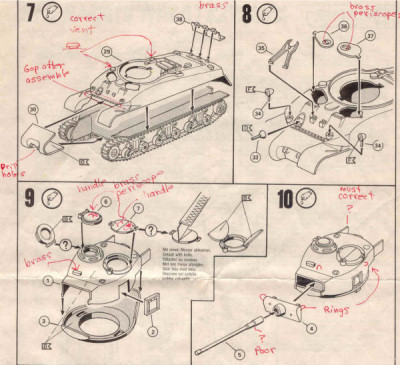
Revell'due south exploded-view kit instructions are good and come up in 12 steps. Water slide decals are for one tank of the 40thursday Tank Battalion, seventh The states Army, 1945.
The Eduard Etched Brass Item Set #22 014 for the Revell kit
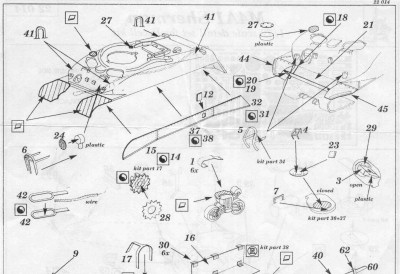
This etched brass gear up was released in 1995 for the so new Revell M4A1 kit and corrects or improves many of Revell's inadequate parts. Parts included are runway skids, headlight & periscope guards, 50-cal. armament box & storage brackets, tool brackets, and new fenders, etc. Also included are flat brass handtools that I exercise not recommend using. This set should help with Trumpeter's and ESCI'due south kit too.
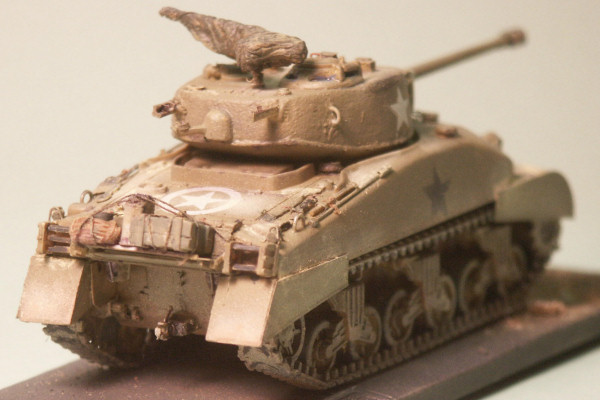
The Revell model with LEVA turret represents a late-war M4A1(76) with muzzle suspension, delivered to the U.s.a. Regular army towards the cease of WW2. Many parts of this model accept been scratchbuilt-detailed or taken from Dragon M4 kits: such as the airfilters, some handtools, spare track blocks, stowage, towing hitch and machine gun brackets on the turret rear. Unfortunately some basic parts similar the tow hitch are missing from Revell's model.
ESCI-Italeri M4A1 with Revell Turret kitbash
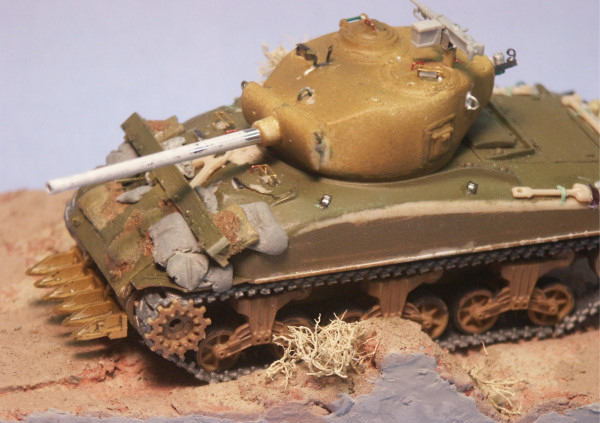
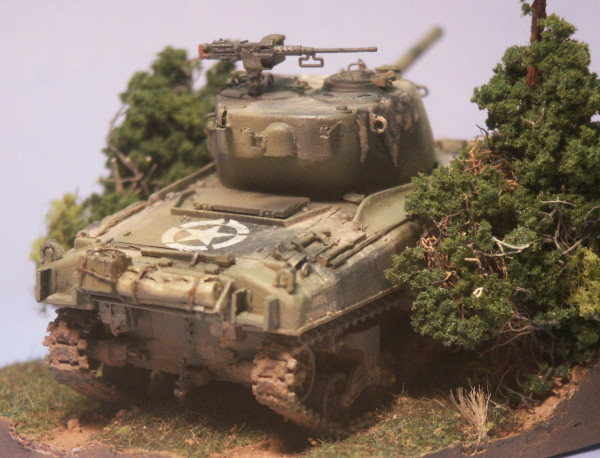
The ESCI [Italeri] M4A1 model every bit sold is a rare 75-mm armed 'big-hatch' Sherman. "Large hatch" refers to the larger driver and co-driver hatches. Few of these big-hatch M4A1's were built with the 75-mm armed turret and it appears that most of those were used as amphibious Duplex Bulldoze tanks [Those larger hatches must have been attractive for a quicker escape if the DD tank should sink?] The ESCI hull makes a more common 76-mm armed tank and is also dressed upwards with hatch handles fabricated from copper wire, etched-contumely periscope guards, and scratch tow-cable guides. The Revell turret was used with my ESCI hull since it has the earlier turret hatch configuration. The Revell turret has been improved with a turned aluminum gun butt, wire elevator rings, hatch handles and a turned-aluminum gun barrel, and etched brass parts. One matter that ESCI's engine deck is missing is an additional fuel cap on the engine deck. I have seen at least 1 programme as well missing this fuel cap so I am not greatly concerned over it not being there.
The top edge of the ESCI hull was softened with a sanding stick, every bit the M4A1 hull appears more rounded in the plans and photos I have. On the nose is a timber & sandbag supplemental armor, and the hedgerow cutter, both resin parts formerly available from LEVA. The sandbag armor is somewhat fictitious and enhanced with additional sandbags made from epoxy putty. Link & length ESCI tracks were used rather than the horrible ESCI polyethylene ring tracks.
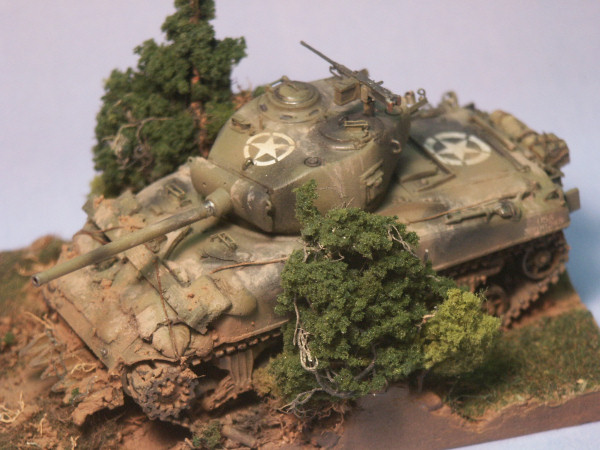
The ESCI hull with Revell turret in what I wished to be a dramatic scene of a US Army Sherman penetrating the Normandy bocage during Performance Cobra. The tank is finished in Model Principal olive drab and Poly-South grimy black acrylic paint. To avoid having to comprehend much of the model'due south bow in freshly ripped up vegetation, roots and upturned earth I opted to model it as the second vehicle coming thru the penetration. A few infantry figures will somewhen be added.
Trumpeter M4A1 kit
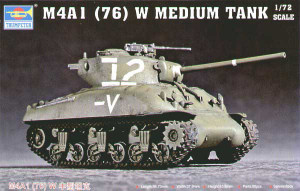
Trumpeter'south box art is unique in showing a photo of the assembled and painted model.
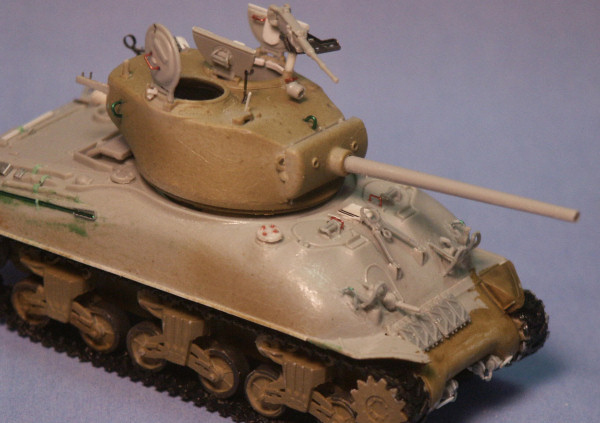
The Trumpeter M4A1 model is largely congenital out of the box and with a few aftermarket or scratchbuilt details compared to the other two models. Trumpeter's hull is notably more rounded than the other bandage hull kits. The tools were molded onto the hull, which I did not like; several tools were therefore cutting off and replaced. Braces were added to the front fenders. A hull ventilator was added betwixt the commuter and co-driver hatches, and details added to the exterior and interior of the open hatches. The solid molded-in hull lifting rings accept been shaved off but not yet replaced with copper wire. Spare tracks were added to the hull nose equally on the Israeli Sherman depicted in Zaloga's reference book but not noted on Trumpeter's box art. What cannot be seen are five large recessed locator marks on each side of the lower hull that are actually fatigued into the associates drawings [see below browse]. These are locating marks for the HVSS pause available in a different kit. Please fill up these in. Trumpeter's band tracks worked well and I think expect skilful.
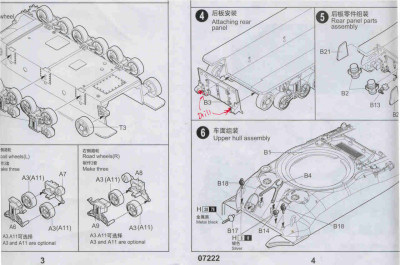
Trumpeter's exploded-view assembly instructions are decent and on par with others. Ane affair interesting and distinct with trumpeter's M4 models is the inclusion of a option of either iv one-piece simplified bogies, or four detailed 4-part wheel/bogie assemblies. This leaves us something to replace Revell'south oversize roadwheels?
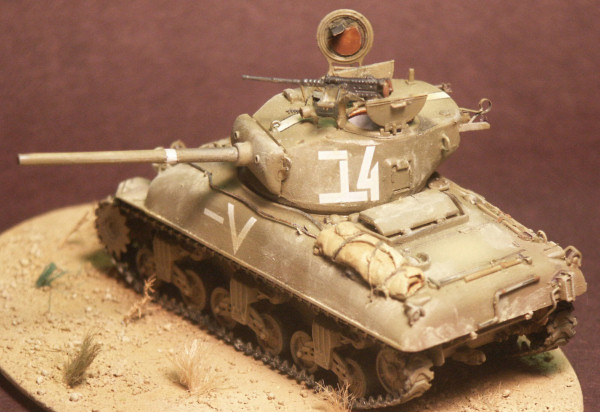
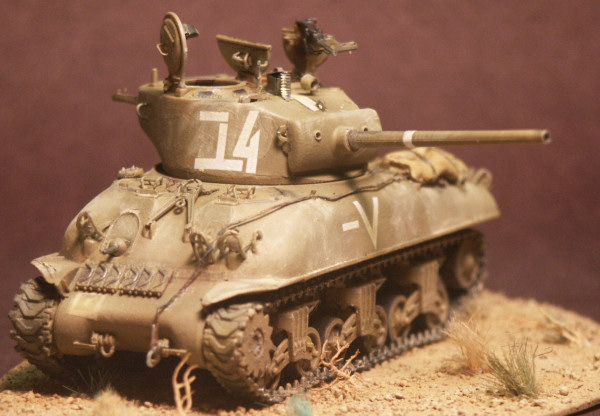
The competed Trumpeter M4A1 built as an Israeli M1 as seen during maneuvers in 1961; painted and detailed co-ordinate to photos in Agree'southward Tank Battles of The Mid-Due east Wars. Overall I am very happy with the finished model and I like the Trumpeter kit, despite the turret hatches beingness also large. While most M4A1 hulls I have seen accept a notch on the hull stern exposing more of the rear doors, Trumpeter'southward stern goes directly across from the left to the right sides. This deviation is meliorate seen in Photo iv to a higher place showing the rear of all three Sherman models adjacent to each other. I accept only seen several photos of this hull rear and have no pertinent information as to when it was introduced and why.
At this fourth dimension the model still awaits several crew figures. The Trumpeter decals applied well and disappeared well over a gloss glaze. A white stripe on the turret roof was non included in the kit decals and added from my box of spare markings. Trumpeter includes h2o-slide decal markings for two postal service-WW2 Israeli Shermans, and for ane US Ground forces M4A1, unfortunately there is instruction for only one M4A1, an Israeli tank.
The Dragon M4A1
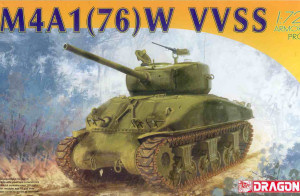
Dragon's boxart is decent and adequately shows a vehicle of the US 2nd Armored Division, without cage intermission and in its natural setting in France, 1944.
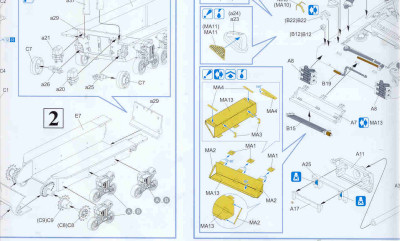
Dragon'south exploded-view instructions announced good and take boosted color blueish and yellow colors to help brand assembly more clear. The gold colour denotes the etched brass parts included inside [rear stowage racks, light guards, etc.; just alas no periscope guards which Dragon does in besides-thick styrene]. While Dragon's M4A1(75) kit included 2 sets of tracks, this model just has i set of one-piece band tracks. Dragon includes many unused parts, which can be used to improve the ESCI, Trumpeter and Revell M4 kits. Water slide decals and good placement instructions for five unlike tanks are included.
Conclusions
In the box, unassembled, the Dragon kit appears to be best of the lot for a display model as far as particular, number of parts and overall accuracy. My adjacent favorite is the Trumpeter model that was a pleasance to build and I call back looks nifty despite the abrasive turret hatch problem. My personal observation is that Trumpeter has a bad habit of perchance rushing models into production without proper enquiry and measuring. Or perchance they tin can non make up one's mind on which market Trumpeter wishes to serve: the display modeler or the wargaming modeler? So they make careless compromises or mistakes. The Trumpeter M4A1 is my pick for a adept wargaming kit, followed past Revell and the ESCI-Italeri M4A1.
Regarding the tracks, more venomous words in Braille Calibration seem to exist over flexible band tracks versus link and length tracks. My findings is that it depends more on how well the kit tracks are designed and rendered rather than whether they are ring or private links. True, in one/35-scale I have never seen a band track look as good as a well-washed individual link track, only not so in one/76 or 1/72. Trumpeter and Dragon 1/72 band Sherman tracks look smashing and glue down well to the wheels. ESCI former band tracks are of stiff polyethylene and are difficult to work with and resist most mucilage known to modelers. Hasegawa band tracks typically lack particular but are better to piece of work with. The Revell & ESCI link & length tracks don't have the other's authentic item and the blight of link & length tracks is trying to become them straight.
References
M4 SHERMAN AT War, by Michael Green & James D Brown, Zenith Press [2007]. An excellent softcover book covering the evolution of the M4, a mechanical description, and with color photos, interior photos, historical photos and line drawings.
M4 (76mm) Sherman Medium Tank 1943-65, by Steven Zaloga & Jim Laurier, New Vanguard 74, Osprey Publishing [2003]. A practiced cheap softcover book roofing the history and apply of the 76-mm gun armed Sherman, a serial noted for their swell color plates.
Sherman In Action, past Culver & Greer, Squadron/Signal Publications ARMOR No. 16 [1977]. A adept, inexpensive softcover book in the noted volume serial geared to the modeler. Highly recommended, but unfortunately completely leaves out coverage of the M4A2 and M4A4.
TANK BATTLES OF THE MID-EAST WARS (1) 1948-1973, by Steven Zaloga, Concord Publications [1996]. A good softcover publication with many b & w photos, color plates, and extensive captions and text.
http://www.172shermans.com/sherman_M4A1_list.htm Link to Doug Chaltry's fine in-box review of the Revell M4A1 and other electric current M4A1 model kits.
Back to Construction Reviews
Back to Tabular array of Contents

Source: https://www.172shermans.com/SBrezinski_M4A1-76_compare.htm
Posted by: reidwitua1960.blogspot.com
0 Response to "How To Draw A M4 Sherman Tank"
Post a Comment